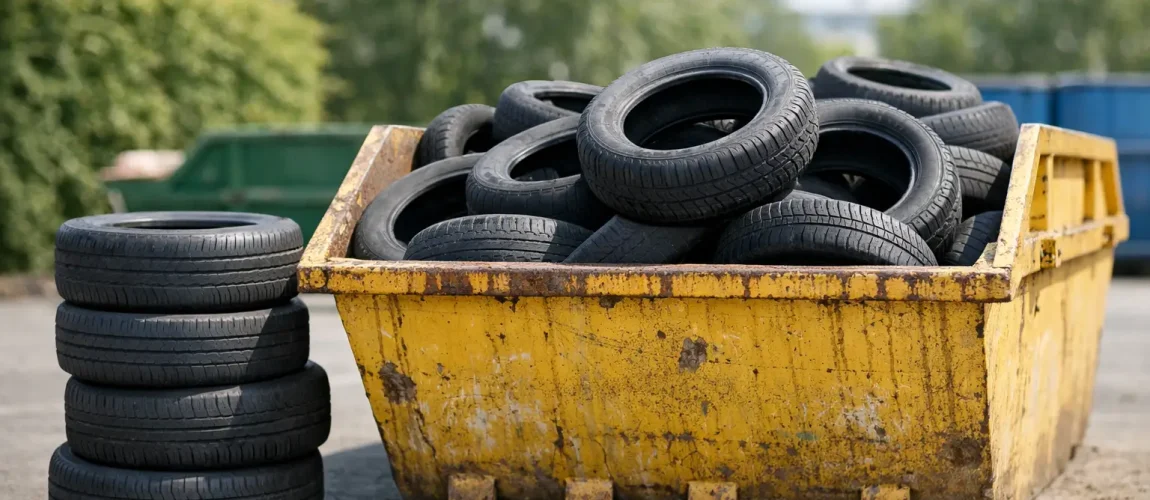
If you have cleared out a garage, stripped an old van, or tidied up after a property job, the question comes up quickly – can tyres go in skips? In most cases, no, they should not be placed in a general skip unless you have agreed it in advance and the provider has confirmed they can take them as a separate chargeable waste stream.
That catches people out because tyres look like straightforward bulky waste. They are not. Tyres are handled differently from mixed rubbish, builders’ waste, or general household clearance because of how they must be processed after collection. If you put them in a skip without checking first, you can end up with extra charges, delays, or a wasted collection.
Can tyres go in skips or not?
The short answer is that tyres usually cannot go in skips with general waste. Most skip hire firms will class them as restricted items, in the same way they may restrict things like plasterboard, fridges, paint tins, gas bottles, asbestos, batteries, or electricals.
The reason is not that tyres are impossible to remove. It is that they need separate disposal and treatment. They cannot simply be mixed through ordinary skip contents and sent on as standard waste. Once tyres appear in a skip, they often have to be pulled out and managed separately, which adds time, cost, and compliance issues.
That is why a local skip company will normally ask you to keep tyres out unless they have specifically said they can take them.
Why tyres are treated differently
Tyres are made from tough mixed materials including rubber, steel and textile fibres. They do not break down like ordinary waste, and they are not something a waste operator can just leave mixed in with hardcore, wood, soil, or general rubbish.
There is also the issue of fire risk and storage controls. Large volumes of tyres need careful handling and proper onward processing. From a waste management point of view, they are a specialist item, not a standard skip load.
For the customer, the main point is simple. A skip is designed for common job waste, but not every item from a job can go in it. Tyres fall into the category that needs checking first.
What happens if you put tyres in a skip anyway?
Usually, one of two things happens. The driver or yard team spots them and removes them for separate charging, or the collection is flagged and you are contacted before the waste can be processed.
Neither option is ideal if you are trying to keep a job moving. If you are a landlord on a tight turnaround, a builder clearing a site, or a householder trying to get everything done in one go, that sort of hold-up is frustrating and avoidable.
This is why clear advice matters before the skip arrives. If you know you have tyres to get rid of, mention it when booking. It is much easier to plan for them from the start than sort it out afterwards.
Are there any situations where tyres can go in skips?
Sometimes, yes – but only by prior arrangement.
Some waste operators can accept tyres if they are declared in advance and charged separately. In that case, they are not really being accepted as part of normal mixed skip waste. They are being collected through the same job but treated as a separate waste item.
It can also depend on quantity. One or two car tyres from a domestic clear-out may be easier to deal with than a pile of van, 4×4, or commercial vehicle tyres from a workshop or yard. The more tyres involved, the more likely they will need a dedicated disposal arrangement rather than standard skip hire.
So if you are asking can tyres go in skips, the honest answer is: usually not as part of the normal load, but sometimes by agreement if the provider offers that service.
The best way to dispose of old tyres
For most people, the right route is to keep tyres separate from the skip and arrange proper disposal through an approved outlet. That might mean taking them to a site that accepts tyres, returning them through a garage when new tyres are fitted, or asking your waste company whether they can collect them as a separate item.
If you are already hiring a skip for the rest of the waste, this often still works well. Put your wood, rubble, garden waste, old furniture, packaging, and general junk into the skip if those materials are allowed, and keep the tyres aside for the right disposal channel.
That way, you avoid contamination of the load and keep the collection simple.
Tyres from homes, garages and renovation jobs
Domestic customers often find tyres during jobs that were never really about vehicles in the first place. You clear a shed and there are two old tyres behind the lawnmower. You move into a house and find four in the garden. You empty a garage and there is a stack left by a previous owner.
In those situations, it is easy to assume they can go in with everything else. That assumption is where trouble starts.
For a straightforward house or garden clearance, treat tyres as separate from the outset. It saves time, and it means your skip can be used properly for the waste it is meant to carry.
Tyres on trade and commercial jobs
For builders, landlords, site managers and other trade customers, tyre disposal is even more important to flag early. A mixed skip from a renovation, strip-out or site tidy-up may already contain different waste types that need proper handling. Adding undeclared tyres creates another issue, and one that can affect the whole load.
If the waste is coming from a unit, lock-up, forecourt, workshop, or commercial yard, it is worth checking whether there are tyres on site before booking collection. That helps avoid surprises on the day.
A practical waste service should make this easy. If you tell the provider what you have, they can usually point you to the right option quickly.
What else should stay out of a skip?
People ask about tyres because they are bulky and awkward, but they are not the only item that needs special handling. As a rule, anything hazardous, pressurised, electrical, liquid, or difficult to process separately should be checked before loading.
That includes asbestos, gas cylinders, paint, solvents, oils, batteries, fridges, freezers, televisions, fluorescent tubes, and often plasterboard. Some firms can take certain items by arrangement, while others will not accept them at all. It depends on the waste stream, the facility, and the licences involved.
The safest approach is not to guess. Ask before the skip is delivered.
Why asking first saves money
Most customers are not trying to bend the rules. They just want to get rid of waste in one go and move on with the job. But restricted items are where cheap skip hire can quickly become expensive if there is a problem at collection or sorting.
When a company prices a standard skip, that price is based on expected waste types. If the load contains materials that require separate treatment, the disposal cost changes. That is why extra charges appear.
A reliable local operator will be upfront about that. If a tyre can be handled separately, you should know the cost before collection. If it cannot, you should be told clearly so you can make other arrangements.
That kind of straight answer matters, especially when timing and budget are tight.
Can tyres go in skips with a local skip hire company?
If you are booking locally in Wolverhampton or the surrounding area, the right question is not only can tyres go in skips, but can your skip hire company accept them by prior arrangement. Policies can vary slightly, but the general rule stays the same – do not put tyres in unless you have been told yes.
For example, a family-run operator with its own licensed waste facility, such as Bushbury Skip Hire Ltd, is in a good position to give clear guidance on what can go in the skip, what needs separating, and what can be handled another way. That clarity is worth having before the skip is dropped off.
If you are unsure, ask when booking and be specific. Say how many tyres you have, what type they are, and whether they are loose on their own or part of a larger clearance. A quick phone call can save a lot of hassle later.
The simplest rule is this: use your skip for the waste it is meant for, and keep tyres out unless the company has agreed to take them. That keeps your job moving, your costs clearer, and your waste handled the right way from the start.