
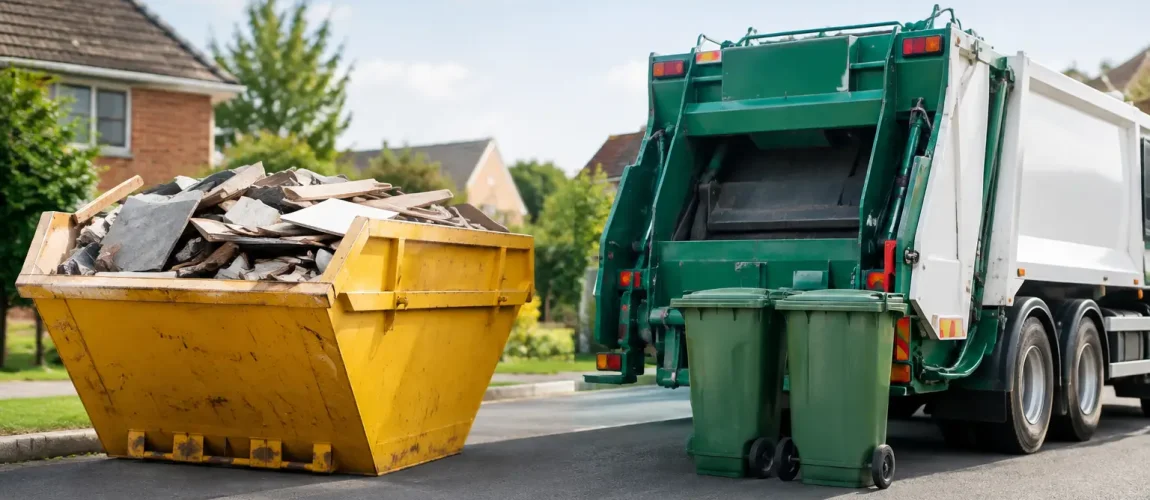
A broken sofa in the hallway, rubble piling up after a bathroom refit, or a garden full of cuttings can quickly turn into a disposal problem. When deciding between skip hire or council collection, the right choice usually comes down to how much waste you have, what it is made of and how quickly it needs to go.
A council bulky-waste collection can be useful for a small number of household items. A skip is often the more practical option for clearances, renovations, garden work and building jobs where waste builds up over several days. Here is how to make the call without paying for the wrong service or being left with a pile of rubbish on the drive.
Skip hire or council collection: the key difference
Council collections are generally designed for occasional bulky household items such as furniture, mattresses or white goods. You normally book a collection slot, place approved items outside as instructed and ensure they are accessible on the day. This can suit a tenant replacing a sofa, or a household with one or two unwanted large items.
Skip hire is designed for projects that produce a larger volume or a mix of permitted waste. The skip stays at your property or site while you fill it, allowing you to clear rooms, strip a garden, remove old kitchen units or deal with builders’ waste as the job progresses. Once it is full, the skip company collects it and takes the contents for sorting and processing.
Neither option is automatically better. Council collection is often sensible when the job is genuinely small and you can work around the available appointment. A skip gives you more capacity, more control over timing and a far easier way to manage a proper clearance.
When a council collection makes sense
A council collection is worth considering if you have a limited number of items that fall within the service rules. For example, you may have an old wardrobe, a washing machine and a mattress after furnishing a flat. If they are accepted, can be safely left in the required location and you are happy with the collection date, there may be no need for a skip.
It can also be the simpler option when access is tight. A skip needs a suitable place to be dropped, whether that is a private drive, yard or road space with the right permission. If a property has no drive and a narrow road makes a skip difficult, a booked bulky-item service could be more convenient for a very small load.
The limitation is that council schemes are not general-purpose waste disposal. They may restrict the number of items, charge per collection, exclude DIY waste and refuse loose rubbish, bags, timber, rubble or garden clearances. Rules and waiting times can change, so always check the current local conditions before relying on it.
When hiring a skip is the better option
A skip comes into its own when waste is more than a handful of bulky items. If you are emptying a house before a sale, renovating a property, clearing a landlord’s let, landscaping a garden or working on a building site, multiple council bookings and trips to the tip soon become time-consuming.
A skip also keeps the work area safer and tidier. Rather than stacking timber, old fittings, soil and bags around the property, you have one contained place for waste. That matters on a busy domestic project and even more on commercial sites, where loose rubbish can get in the way of trades and customers.
For many Wolverhampton households, a 2-yard mini skip suits a modest garden tidy or a small clear-out. Larger jobs may need a 4-yard, 6-yard or 8-yard skip, particularly where there is a mix of bulky household waste and renovation materials. Choosing the size carefully is usually cheaper than ordering a skip that is too small and needing a second one.
Compare the real cost, not just the booking price
It is easy to assume a council collection will always be cheaper because it handles fewer items. That is not necessarily true once you consider the whole job. A single collection may be good value for a sofa and a few approved items, but it is poor value if you still need to arrange separate disposal for carpet, fencing, plasterboard, bagged rubbish and broken fixtures.
With skip hire, the price normally covers delivery, collection and responsible disposal of accepted waste. It gives you a fixed container for the duration of the job, which can reduce costly tip runs, fuel use and time away from the work. For tradespeople and landlords, that time saving is often the deciding factor.
Be honest about the waste you expect to produce. Heavy materials such as soil, hardcore, bricks and rubble can make a skip reach its weight allowance long before it looks full. If your project is mainly inert waste, say so when requesting a quote. The right advice at the start helps avoid problems later.
Think about timing and access before booking
Council bulky-waste collections usually operate to set dates and routes. That is fine if your job can wait. It is less helpful if builders are due next week, tenants are moving out, or you need a property clear for handover.
A local skip service is generally more flexible for planned work. You can arrange delivery close to the start of the project and collection once the skip is ready. Do not fill a skip above the top edge, as an overloaded skip cannot be transported safely.
Where the skip will sit is equally important. A private drive is usually the simplest option, provided there is enough width and solid ground. If it needs to go on a public road, a permit may be required from the local authority. Allow extra time for this, and make sure the skip provider knows where it is intended to be placed.
Also consider the route for the delivery lorry. Low branches, parked cars, tight gateways and overhead cables can all affect safe access. A quick check before booking can prevent delays on the day.
What you can put in a skip
Most general skips can take common household, garden and builders’ waste. This can include wood, metal, cardboard, plastics, furniture, soil, bricks, tiles, green waste and non-electrical fittings. Mixing these materials is often one of the main reasons a skip is useful for a full clearance.
However, some materials need separate handling and should not be put in a general skip. These commonly include paint, gas bottles, asbestos, tyres, batteries, fridges and freezers, chemicals, oils and other hazardous waste. Plasterboard may also need to be kept separate because of disposal rules.
Council collections have their own exclusions, particularly for DIY materials and hazardous items. Whether you choose a skip or a collection, never leave unapproved waste out for removal. It can lead to rejected collections, extra charges or fly-tipping problems.
Responsible disposal matters after collection
The job is not finished when the waste disappears from your property. Whoever collects it should be licensed to carry waste and should have a clear process for handling it legally. Cheap, unofficial removal can become expensive if your rubbish is dumped illegally and traced back to you.
Bushbury Skip Hire is a family-run local operator with its own licensed waste sorting facility in Wolverhampton, recycling at least 90% of collected material where possible. For customers, that means a straightforward way to deal with waste while keeping reusable materials out of landfill.
A simple way to decide
Choose a council collection when you have a small, accepted set of bulky household items, suitable access and no urgent deadline. Choose skip hire when the waste is mixed, ongoing, heavy, bulky or linked to a larger clearance or renovation.
If you are between the two, picture the waste at the end of the job rather than at the start. A couple of old chairs may stay a council collection. A shed clear-out, bathroom strip-out or move-out clearance rarely does – and having the right skip on site can make the whole job feel manageable.