
A builder clearing a shop unit, a landlord emptying a property or a café replacing old equipment all have the same legal responsibility: business waste cannot simply go in a household bin or be handed to the first person with a van. Company waste regulations in Wolverhampton are there to make sure waste is stored safely, collected by the right people and taken to a legal site.
For most local firms, complying is straightforward. It comes down to knowing what waste you have, using a registered carrier, keeping the right paperwork and arranging a permit if your skip needs to sit on the road. Getting those basics right protects your business from fines, fly-tipping problems and unnecessary delays on site.
Your duty of care for business waste
Every business that produces, imports, carries, keeps, treats or disposes of waste has a legal duty of care. This applies whether you run a small office, manage rental properties, operate a trade business or oversee a busy construction site.
In practical terms, you must keep waste contained so it cannot escape, be blown about, cause a nuisance or create a safety risk. You must also take reasonable steps to prevent someone else disposing of it illegally. Putting commercial bags beside public bins, using a neighbour’s domestic bin or leaving waste on land without permission can all create problems.
The person or company taking your waste away must be authorised to do so. Do not rely on a verbal promise that it will be recycled or tipped properly. Ask to see their waste carrier registration and make sure the collection arrangement is clear before the job starts. If your waste is later found fly-tipped, the original producer can be investigated too.
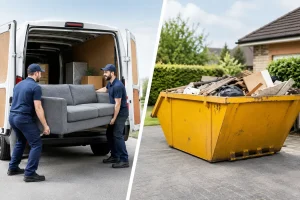
This is particularly relevant for landlords and tradespeople. Waste from repairs, refurbishments, clearances and maintenance work is generally commercial waste, even where the property itself is a house or flat. A domestic-looking load is not automatically domestic waste once it comes from business activity.
Keep a waste transfer note
For ordinary non-hazardous business waste, you normally need a waste transfer note. This is the record that shows what was collected, who passed it on, who received it and where responsibility changed hands.
A transfer note should describe the waste accurately enough for it to be handled safely. “Mixed waste” on its own is rarely helpful. A better description might be mixed construction and demolition waste, cardboard and general commercial waste, or green waste from grounds maintenance. It should also include the quantity, how the waste is contained, the date of transfer and the carrier’s registration details.
For regular collections of the same type of waste, one season ticket transfer note can cover repeated transfers for up to 12 months. Keep records for at least two years. If you produce hazardous waste, the paperwork rules are stricter and records should be retained for longer.
Paperwork may feel like an extra task when you are trying to finish a job, but it is useful protection. It gives you a clear audit trail and shows that your business has taken reasonable steps to dispose of waste lawfully.
Using a skip for commercial waste in Wolverhampton
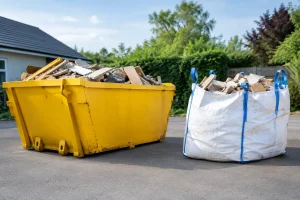
A skip is often the simplest option for a one-off clearance, a building project or a steady flow of bulky site waste. The right size depends on the material and the space available, not just the size of the job. Ordering too small a skip can mean extra collections, while an oversized skip can take up valuable room and cost more than needed.
For lighter jobs such as office clear-outs, small shop refits or garden maintenance, a mini or midi skip may be enough. Renovation work, builders’ waste and larger property clearances often need more capacity. Keep the load level with the top of the skip. An overfilled skip cannot be safely sheeted and may not be collected.
Where possible, place the skip on private land such as a driveway, yard or site compound. This avoids the need for a highway permit and usually makes delivery easier. Check the access first: low branches, parked vehicles, gates, narrow entries and overhead cables can all affect where the lorry can safely place it.
When a road permit is needed
If the skip will sit on a public road, pavement or verge in Wolverhampton, a permit is normally required from the local highway authority. The skip provider will usually arrange this, but it needs to be discussed when booking because permits take time and the site may have restrictions.
Do not assume a permit will be granted just because there is space outside the premises. Busy roads, parking controls, bus routes, junctions and pedestrian access can all affect the decision. The skip may also need lights, cones or other safety measures, particularly during darker hours.
A permit is for the position and period agreed. If works run over, contact the provider early rather than leaving the skip in place after the permit expires. The cost and lead time can vary, so a private-land placement is worth considering where it is practical.
Separate waste before it becomes a problem
Mixed loads are convenient, but separating materials can improve recycling and avoid contamination. Cardboard, clean timber, metal, soil, hardcore and green waste can often be recovered more effectively when they are kept apart. This can be especially worthwhile for trades with regular waste streams.
There are limits. A small one-off job may not have room for several containers, and separate collections are not always the cheapest route. The sensible approach is to identify the materials that make up most of your waste and keep those apart where it genuinely reduces cost or improves recycling.
Bushbury Skip Hire Ltd sorts collected waste at its licenced Wolverhampton facility, with a commitment to recycle at least 90% of materials. Even so, businesses can help by keeping unsuitable items out of the skip and avoiding the mix of materials that makes recovery harder.
Waste that needs a different arrangement
Some materials must not go into a general mixed-waste skip. They need specialist collection, separate treatment or prior agreement because they can be hazardous, difficult to recycle or unsafe to handle.
This commonly includes:
- asbestos and suspected asbestos-containing materials
- chemicals, solvents, paints, oils and fuel containers
- gas cylinders, batteries and fire extinguishers
- electrical items such as fridges, monitors, TVs and other WEEE
- clinical waste, sharps and medicines
- tyres, fluorescent tubes and certain upholstered seating
Do not guess with asbestos. If insulation board, textured coating, pipe lagging, old floor tiles or another material could contain asbestos, stop work and arrange a competent assessment. Breaking it up or loading it into a skip can put people at risk and create a much bigger disposal issue.
Plasterboard is another common point of confusion. It should generally be kept separate from biodegradable waste because of the gases that can be produced in landfill. Tell your waste provider about plasterboard before delivery so the right disposal route can be arranged.
Hazardous waste requires a consignment note rather than an ordinary transfer note. It also needs a carrier and receiving facility authorised for that particular material. The description matters: “paint” or “chemicals” is not enough when the waste may have different hazards and treatment requirements.
Do not use domestic bins for business waste
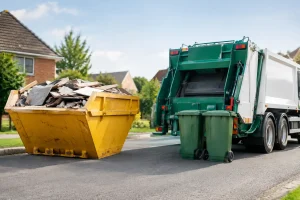
Commercial waste must be collected under a suitable business waste arrangement. Household collections and household recycling centres are designed for residents disposing of their own waste, not firms clearing stock, contractors removing job waste or landlords dealing with managed properties.
This catches out people running small businesses from home. Packaging, trade waste, customer returns and materials from paid work can all count as commercial waste. The right arrangement may be a regular collection, a one-off skip or a licensed carrier collection. It depends on the volume, frequency and type of waste.
A quick check before you book
Before arranging disposal, establish what materials are involved, whether any are hazardous and whether the skip will be on private land or the highway. Then confirm the carrier is registered, ask what paperwork you will receive and make sure everyone on site knows what cannot go into the container.
That small amount of planning keeps the job moving, helps recycle more of the material and gives your business the proof it needs if questions are ever raised. When you are unsure about an item or placement, ask before it reaches the skip – it is always easier to deal with waste correctly at the start.