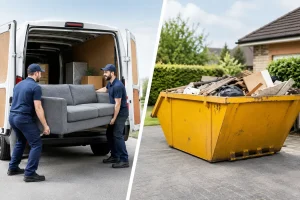
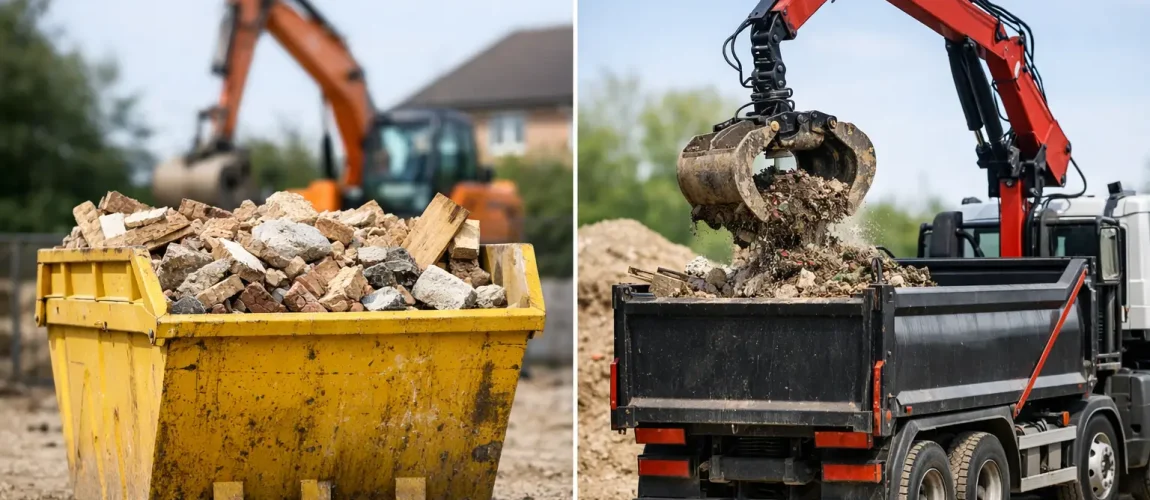
If you are weighing up skip hire or grab hire, the right choice usually comes down to one simple question – are you clearing waste steadily over a few days, or do you need a large amount taken away in one go? That decision affects cost, access, convenience and how smoothly your job runs, whether you are clearing a garden in Wolverhampton, managing a house renovation or keeping a building site moving.
Skip hire or grab hire – what is the difference?
A skip is left on site for you to fill in your own time. You choose the size, load it as the job progresses, and arrange collection when you are done. For many household and trade jobs, that flexibility is the main advantage.
Grab hire works differently. A grab lorry arrives, loads waste using a hydraulic arm and removes it there and then, or very quickly if pre-booked for collection. It is often used for heavier materials and larger loose waste piles, especially where speed matters.
Neither option is better in every situation. It depends on the type of waste, how much there is, how easy the site is to access and whether you want time to load gradually or need the waste gone straight away.
When skip hire makes more sense
Skip hire is usually the better option when waste is being created over time rather than all at once. If you are doing a bathroom refit, a kitchen rip-out, a loft clear-out or a garden tidy-up over several days, a skip gives you somewhere practical to put everything as you go.
That is why skips are popular with householders, landlords and tradespeople. You can keep the site tidy, avoid repeated trips to the tip and work at your own pace. For smaller domestic jobs, a mini or midi skip is often enough. For heavier renovation waste or mixed builders’ waste, a larger skip may be the more sensible choice.
A skip can also be more cost-effective when labour is limited. You do not need to have all the waste ready in a neat pile for collection. You simply load it bit by bit when it suits you.
There are a few things to think about, though. You need enough space to position the skip safely, either on a drive, private land or sometimes on the road if the correct permit is arranged. You also need to load it properly. Overfilling is not allowed, and some waste types need to be kept out altogether.
Good jobs for skip hire
Skip hire is often the right fit for house clearances, garden projects, light demolition, home improvements, shop refits and ongoing building work. It works especially well when different waste materials are being produced over a few days and you want a simple, contained way to manage them.
When grab hire is the better choice
Grab hire tends to suit jobs where there is a large volume of waste already waiting to be collected. If you have piles of soil, hardcore, rubble or green waste stacked up outside, a grab lorry can often remove it faster than arranging a skip and loading it manually.
This can be a strong option for groundworks, landscaping, site clearances and heavier construction waste. Because the lorry does the loading, it can save time and labour. That matters on busy commercial jobs where delays cost money.
Grab hire can also be useful where skip placement is awkward. If there is no room on site for a skip to sit for several days, or the waste is already accessible from the road or driveway, a grab collection may be the easier route.
The trade-off is timing. Grab hire is best when the waste is ready to go. It is not designed for jobs where rubbish builds up slowly over a week. You also need suitable access for the lorry and enough room for safe operation of the grab arm.
Good jobs for grab hire
Grab hire is commonly used for muck away, brick and concrete waste, excavation spoil, large garden clearance piles and site waste that has already been gathered together. It is especially handy when materials are heavy and awkward to shift by hand.
Cost depends on more than the headline price
People often start by asking which is cheaper – skip hire or grab hire. The honest answer is that it depends on the job.
A skip can be better value when you need several days to fill it and the waste volume matches the skip size well. It gives you predictable pricing and avoids paying for a same-day bulk collection that may be larger than you really need.
Grab hire can work out better value when you have a lot of heavy waste in one place and would otherwise spend time and labour loading a skip by hand. It may also reduce the need for multiple skips on larger jobs.
The cheapest-looking option is not always the most economical overall. Labour time, permit needs, access restrictions and how quickly the waste needs to disappear all affect the true cost.
Access is often the deciding factor
Access can settle the question before price even comes into it. If you have a driveway, yard or clear roadside position, a skip is often straightforward. If the skip would need to go on the public highway, permits and placement rules need to be considered.
With grab hire, the issue is different. The lorry needs enough room to get close enough to the waste and use its arm safely. Tight residential roads, parked cars, low cables or restricted access can make a grab collection difficult.
For domestic customers, this often comes down to layout. A skip works well when there is space to leave it. A grab lorry works well when there is space to reach the waste and remove it in one visit.
Think about the type of waste
Not all waste is equal. General household rubbish, renovation waste, timber, old furniture and garden waste are commonly suited to skip hire, depending on the exact material. Soil, hardcore and rubble can also go into skips, but because they are heavy, the skip size and loading limits matter.
Grab hire is particularly useful for loose inert waste such as soil, clay, concrete, bricks and hardcore. These materials are dense, messy and often better handled as a bulk collection rather than hand-loaded bit by bit.
If you have mixed waste, a skip may give you more control. If you have one heavy waste stream in volume, a grab can be the more efficient answer.
For domestic jobs, convenience usually wins
Most household customers are not running a large site. They are clearing out a property, sorting a garden or getting through a renovation without turning every weekend into tip runs. In those cases, skip hire often makes life easier.
You fill it when you want, keep waste contained and avoid having rubbish stacked around the property. That convenience matters just as much as price. A reliable local company that turns up on time and collects promptly makes the whole job less stressful.
For a one-off pile of spoil after landscaping or driveway work, though, grab hire can be the smarter choice. If the waste is already outside and ready, there is no reason to pay for a container to sit there if a lorry can clear it quickly.
For trade and commercial work, speed matters
Builders, landscapers and commercial operators often look at this more practically. How fast can waste be cleared, how much labour will loading take, and will the chosen option hold up the job?
For ongoing work on site, skips remain a dependable choice. They keep waste under control and support day-to-day operations. For major clearances, muck away or heavy material from demolition and excavation, grab hire is often quicker.
That is why many contractors use both at different stages. One is not replacing the other. They solve different problems.
How to choose between skip hire or grab hire
If your waste will build up gradually, you want time to load it, and you have space for a container, skip hire is usually the safer bet. If your waste is already piled up, heavy, loose and ready for collection, grab hire may save time and effort.
It also helps to think about what could go wrong. If you underestimate the amount of heavy waste in a skip, you may need another collection. If you book a grab without proper access or without the waste ready, the job becomes harder than it needs to be.
For customers across Wolverhampton, the best approach is usually the simplest one – explain the job clearly, the waste type, and the access available, then choose the option that fits the site rather than forcing the site to fit the service. Bushbury Skip Hire Ltd sees this regularly with domestic and trade customers alike, and the right advice at the start usually saves money and hassle later.
If you are still unsure, think less about the label and more about the job in front of you. The best waste solution is the one that keeps the work moving, keeps the site tidy and gets everything removed without fuss.