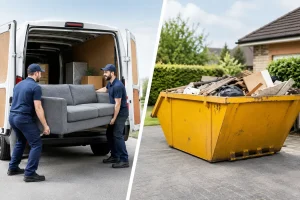

If you are weighing up skip hire versus waste clearance, the right choice usually comes down to one simple question: do you want to load waste in your own time, or do you need it gone quickly with as little effort as possible? For household clear-outs, garden jobs, refurbishments and trade waste, both options can work well. The difference is in cost, access, labour and how predictable the job is.
In Wolverhampton and the surrounding area, that matters more than people think. A straightforward driveway clear-out is one thing. A tight street, ongoing renovation or mixed pile of bulky waste is another. Choosing the wrong service can leave you paying more than you need to, or waiting longer than the job allows.
Skip hire versus waste clearance: what is the difference?
Skip hire means a skip is delivered to your property or site, left with you for an agreed period, then collected when you are finished. You fill it yourself. That suits jobs where waste builds up over a few days or even longer, such as kitchen refits, bathroom rip-outs, garden landscaping or site work.
Waste clearance usually means a team comes to remove the waste for you. In many cases they load it themselves and take it away in one visit. That can be useful when you want the waste gone there and then, or when you do not want the physical work of loading a skip.
On paper, the decision looks simple. In practice, there are trade-offs. Skip hire is often better value when you have enough waste to justify the container and the time to fill it. Waste clearance can be more convenient for smaller jobs, awkward access or situations where labour is the bigger issue than disposal.
When skip hire is the better option
Skip hire tends to make the most sense when the waste is predictable. If you know you are stripping out a room, clearing a garden, replacing fencing or managing waste on a building job, a skip gives you control. You can load as you go, keep the site tidy and avoid having to stack waste in piles while waiting for someone to remove it.
That flexibility is often the biggest advantage. A homeowner doing weekend DIY does not need to finish everything in a single afternoon. A builder on a live job does not want waste bags and rubble slowing down the site. With a skip on hand, the waste can go straight in.
Cost is another reason many customers choose skips. If you have a decent volume of waste, skip hire is commonly the more economical route. You are paying for the container, delivery, collection and proper processing, rather than the added labour of a clearance crew. For heavier materials such as bricks, soil, hardcore and renovation debris, that can make a real difference.
There is also the practical side of compliance. A properly arranged skip service should make it clear what can go in, what cannot, and how the waste will be handled afterwards. For domestic and trade customers alike, that matters. It is not just about getting rid of rubbish. It is about making sure it is handled by a licensed operator and processed responsibly.
When waste clearance may suit you better
Waste clearance is often the better fit when speed is the priority. If you are moving house, dealing with a landlord clearance, emptying a garage or sorting waste left behind by tenants, you may simply want everything gone without loading it yourself.
It also helps where access is awkward. Not every property has room for a skip. Some drives are too small, some streets are too tight, and some locations make permit issues more of a nuisance than people expect. In those cases, a clearance team can sometimes remove waste without the need to position a skip on site for days.
The same goes for customers who cannot do the lifting. A skip is convenient, but only if someone is there to carry the waste out and load it properly. If the job involves old furniture, bulky household items or a lot of loose material, a man-and-van style clearance may feel easier, even if the price is higher.
That said, waste clearance is not always the cheaper option. Once labour, loading time and transport are factored in, costs can rise quickly on larger jobs. What looks inexpensive for a small pile can become poor value when the amount of waste grows.
Cost: where the real difference shows
For many customers, skip hire versus waste clearance comes down to price. The trouble is that people often compare them in the abstract instead of comparing the actual job.
If you have enough waste to fill a small, medium or large skip, hiring the right size usually gives clearer value. You know what the container is for, you know the likely waste type, and you can plan around it. For projects such as refurbishments, roofing work, landscaping and repeated site waste, that usually works out well.
Waste clearance pricing can be less predictable because it depends on volume, labour, loading difficulty and the type of waste being removed. Two piles that look similar from a distance can cost very different amounts if one is loose green waste and the other is dense rubble.
This is why honest sizing matters. A smaller skip that is overfilled is not a saving. Equally, paying a clearance crew for what could have gone neatly into a skip is not always efficient. The best option is the one that fits the waste properly from the start.
Access, permits and timing
Access often decides the issue before price does. If you have a driveway or enough private space, skip hire is usually straightforward. Delivery, collection and loading can all happen with minimal fuss.
If the skip has to go on the road, a permit may be required depending on the location. That is not a reason to avoid a skip, but it is part of the planning. A reliable local provider should explain what is needed and help keep the process simple.
Timing matters too. If your project runs over several days, skip hire is normally easier because the container stays put until the work is done. If you need a one-off fast removal because the property is being handed over, viewed or cleaned, waste clearance may be more practical.
Waste type matters more than most people expect
Not all waste should be treated the same way. General household junk, garden waste, wood, metal, plasterboard, soil, bricks and hardcore each need the right handling. Some materials have weight limits, some need separate disposal, and some are not suitable for mixed loading.
This is where choosing a licensed, facility-backed operator matters. The service should not only remove the waste but sort and process it properly. That protects you from corners being cut and gives trade customers, landlords and homeowners more confidence that the job has been handled as it should be.
For ongoing projects, skips are often easier to manage because the waste stream is clearer. For mixed household clearances, the picture can be less tidy, and a collection service may help if the load is varied and scattered around the property.
A practical way to decide
If your waste will build up over time, if you are happy to load it yourself, and if you want a cost-effective option for a known volume of material, skip hire is usually the better choice. That is especially true for renovations, garden work, building waste and site clearances.
If you need the waste gone quickly, cannot load it yourself, or do not have suitable space for a skip, waste clearance may be the better route. It is often about convenience rather than outright value.
For many local customers, the answer is less about which service is better overall and more about which one suits the job in front of them. A garden overhaul and a same-day flat clearance are not the same thing. They should not be priced, planned or handled in the same way either.
At Bushbury Skip Hire Ltd, the focus is simple: give customers in Wolverhampton a clear, compliant and good-value way to deal with waste, with skip sizes that match the job and waste handled through a licensed local facility. If you are unsure, the best starting point is not a guess. It is a quick conversation about the type of waste, the space you have and how fast you need it gone. That usually makes the right choice obvious.