
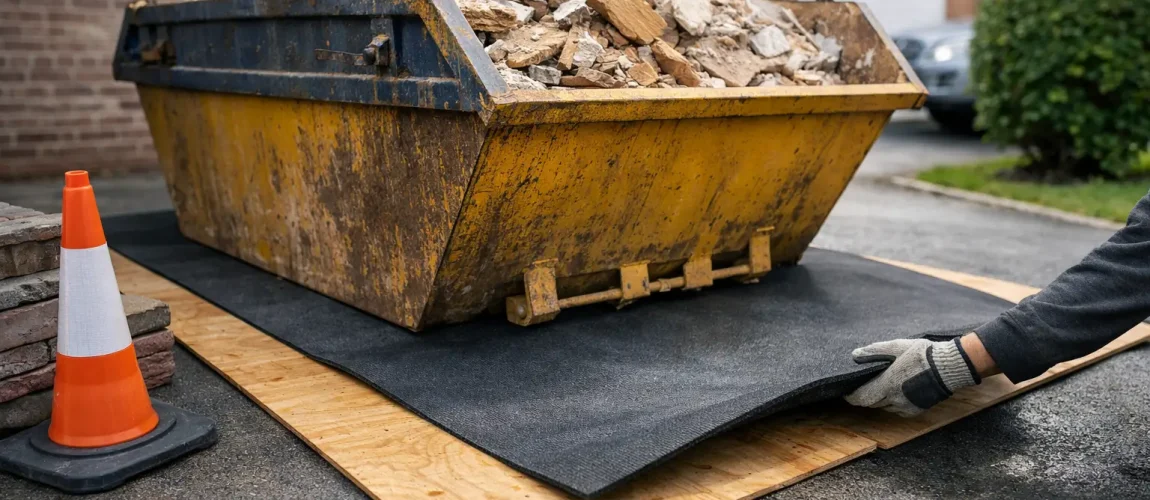
A skip solves one problem quickly – getting waste off site – but it can create another if your driveway is block paving, tarmac, resin or older concrete. If you are wondering how to protect your driveway from a skip, the main aim is simple: spread the weight properly, choose the right position, and make sure the drop is handled carefully from the start.
A lot of driveway damage does not come from the skip just sitting there. It often happens during delivery, when the skip is lowered into place, adjusted, or collected once fully loaded. That is why a bit of planning before the lorry arrives matters more than trying to fix things afterwards.
How to protect your driveway from a skip before delivery
The first job is to look at the surface itself. Not every driveway can take the same weight. A skip on a solid concrete drive in good condition is very different from placing one on older block paving, decorative slabs, resin-bound surfacing or tarmac in hot weather.
If the drive already has weak spots, dips, loose blocks or cracking, the risk goes up. A loaded skip puts concentrated pressure on a small area, especially at the contact points underneath. Even a smaller skip can leave marks if the ground below is not sound.
Before booking, it helps to think about what you are throwing away as well. Light household waste is one thing. Soil, rubble, bricks and concrete are much heavier and can put far more strain on the surface. In some cases, the better option is to hire a smaller skip and have it exchanged, rather than place one large, heavy skip on a driveway that may not be suitable.
Use timber boards to spread the load
The most common answer to how to protect your driveway from a skip is also the simplest: use strong timber boards under the skip. These help spread the weight more evenly and reduce the chance of point loading, scuffing and edge damage.
The boards need to be thick enough to take the weight. Thin offcuts or weak sheet material are not much use. Solid timber planks are generally the safer choice because they create a buffer between the skip and the driveway while supporting the base properly.
They should be laid flat where the skip will rest, with enough coverage for the contact points. If they are too short, too narrow or unevenly placed, you can still end up with pressure marks or movement. It is worth getting this right before delivery rather than trying to slide boards underneath later.
For some surfaces, boards help but do not remove all risk. Resin and decorative paving can still mark under weight, and tarmac can soften in warm conditions. Protection reduces the chance of damage, but it does not make every driveway suitable for every skip size.
Choose the right spot on the drive
Where the skip sits matters almost as much as what sits under it. The best area is usually flat, level and as structurally sound as possible. If one section of the driveway is newer, firmer or better supported underneath, that is often the safer choice.
Avoid placing a skip over drainage covers, weak edging, raised decorative borders or areas where the ground may have settled. Block paving near edges can shift more easily, and slabs can crack if the load is not distributed well. A skip also needs enough clearance for the lorry to place and collect it without dragging across the surface.
It is easy to focus only on the footprint of the skip, but access matters too. If the driver has to make awkward adjustments because cars, walls or gates are too close, there is a higher chance of scraping or sudden pressure on one side. A clear run in and out makes for a cleaner placement.
Match the skip size to the driveway and waste type
Bigger is not always better. Many customers try to avoid a second hire by choosing a larger skip than they really need, but that can be the wrong decision if the driveway surface is the limiting factor.
For lighter domestic jobs such as garden tidy-ups, loft clearances or general household waste, a smaller skip may be easier on the drive and easier to position. For heavy renovation waste, it is worth being realistic about the load. Hardcore, soil and bricks build weight quickly, and overloading a skip is a problem for both transport and surface pressure.
This is where clear advice from a local operator matters. A reliable skip hire company should be able to guide you on size, waste type and whether your chosen location sounds suitable. If there is any doubt, say what kind of surface you have and what the skip will be filled with. That short conversation can prevent a costly mistake.
Why delivery and collection are the highest-risk moments
A skip can sit safely for days, then cause damage in seconds during collection. When the lorry lifts a full skip, the weight shifts. If the angle is awkward or the base sticks slightly, the contact points can dig in or scrape as the skip comes away.
That is why level placement matters at the start. A skip that has settled unevenly, especially on soft or poorly supported ground, is more likely to move badly when it is removed. The heavier the contents, the more obvious that risk becomes.
It also helps to keep the area around the skip clear while it is in use. If waste is piled around the base, the driver may have less room to collect it cleanly. A clear, accessible area gives the best chance of a straightforward lift without dragging or repositioning.
Surface-by-surface advice
Concrete is often the most forgiving surface, provided it is in good condition and not already cracked. Boards are still sensible because they reduce pressure marks and help protect the surface during placement.
Block paving needs more care. Individual blocks can shift, sink or become marked if the load sits unevenly. Strong boards are especially useful here, and it is best to avoid edges or areas where the paving has moved before.
Tarmac is more vulnerable than people think. In warm weather it softens, which makes dents and impressions more likely. Even with boards, a heavy skip on a hot day can leave marks.
Resin-bound and decorative finishes can be the trickiest. They often look tough but can be more prone to scratching, pressure marks or cosmetic damage. If appearance matters as much as function, you may prefer to keep the skip off the driveway altogether.
When the road is a better option
Sometimes the safest answer to how to protect your driveway from a skip is not to put the skip on the driveway at all. If the surface is delicate, sloped, newly laid or already showing wear, roadside placement may be the better option.
That does bring other considerations. A skip placed on a public road normally needs the correct permit, along with lights and markings where required. It can also affect parking and access. Still, for some properties, using the road is the more practical choice if it avoids the risk of driveway repairs.
If you are not sure which is best, ask before booking. A local firm with experience across Wolverhampton and surrounding areas should be able to advise based on property type, access and waste volume. Bushbury Skip Hire Ltd, for example, works with both domestic and trade customers and can help you choose a suitable skip size and placement option without overcomplicating it.
A few mistakes that lead to damage
One common mistake is putting a heavy skip on the drive for convenience without thinking about the actual waste going into it. Mixed household rubbish is one thing, but once rubble and soil start going in, the load changes quickly.
Another is relying on flimsy boards or using none at all. If the base is not protected properly, the contact points take the full force. That is when you see dents, chipped edges and surface marks.
The last one is poor communication on delivery day. If there is a preferred spot, say so clearly and make sure the access is ready. Moving a skip after it has been lowered is not ideal for the driveway or for the job.
The good news is that most driveway damage is avoidable with a bit of planning. A suitable skip size, proper boards, a sound position and a careful drop make a big difference. If you treat the driveway as part of the job rather than an afterthought, the clear-out can stay simple from start to finish.